
- by Harry Lawrence
Do bamboo brush heads fit a Sonicare or an Oral B?
- by Harry Lawrence
Buying guide • Compatibility
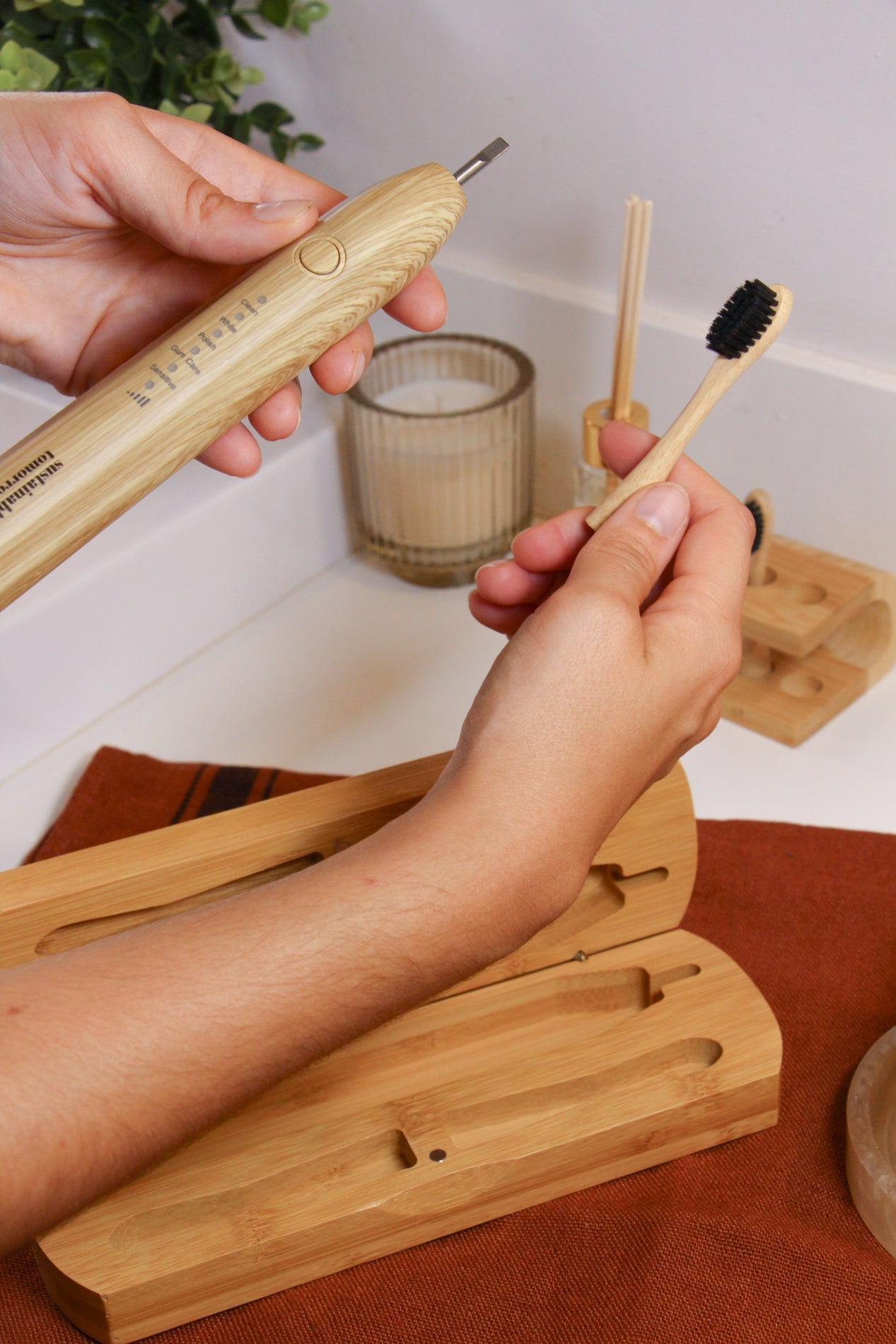
Short answer: yes, with named exceptions. Bamboo replacement heads fit most Philips Sonicare handles and most Oral B handles, so you can switch to a plant based head without replacing a working toothbrush. The exceptions matter though, and most pages that answer this question do not list them.
Sonicare. Bamboo heads fit all Philips Sonicare models except Sonicare Essence, Sonicare Series 4000, Sonicare ProtectiveClean, Sonicare One and Sonicare E Series.
Oral B. Bamboo heads fit all Oral B models except the iO Series.
If your handle is not on either exclusion list, a bamboo head will click straight on and work exactly as a plastic one does.
Almost every guide to sustainable oral care tells you to buy a new toothbrush. That is an odd instruction, because the handle is the part you keep. A working electric handle lasts years. Throwing one away in order to own a greener one is not, on any reasonable accounting, a green thing to do.
The head is different. It is the part that leaves. Dentists advise replacing a brush head roughly every three to four months, and sooner if the bristles splay, which works out at three to four heads a year for most people and more for anyone who brushes hard. Across the lifetime of one handle that is a considerable pile of small plastic objects, none of which are recyclable through household collection.
So the useful question is not which brush to buy. It is whether the brush you already own can take a better head.
| Handle | Bamboo head fits |
|---|---|
| Most Philips Sonicare handles | Yes. Standard snap on fitting. |
| Sonicare Essence | No |
| Sonicare Series 4000 | No |
| Sonicare ProtectiveClean | No |
| Sonicare One | No |
| Sonicare E Series | No |
Compatibility list as published on the Sustainable Tomorrow product page, August 2026. Philips and Philips Sonicare are third party trademarks and we are not affiliated with Philips.
| Handle | Bamboo head fits |
|---|---|
| Most Oral B handles | Yes. Standard push on fitting. |
| Oral B iO Series | No. The iO range uses a different drive and head fitting. |
Oral B is a third party trademark and we are not affiliated with the brand.
This is the part most compatibility pages skip, so here it is plainly.
Newer Philips Sonicare handles carry a feature called BrushSync, which uses a small chip inside the genuine head. It reminds you when the head needs replacing and, on some handles, selects a cleaning mode to match the head you fitted. Third party heads do not carry that chip.
What that means in practice: the brush still works normally, the motor still runs, the cleaning is unaffected. You simply lose the automatic reminder and the automatic mode selection. If you rely on that amber replacement light, you will need to keep track of the date yourself instead, which for most people means putting a recurring reminder in a phone.
One honest note. Our bristles are made from castor seed oil rather than petroleum, and they will break down in a home composting environment. We are not allowed to call them compostable, because that word carries a legal threshold of roughly three months and ours take longer than that.
We would rather tell you that than use a word we cannot stand behind. The bamboo body of the head composts in around six months. A plastic head does not compost at all.
The American Dental Association advises replacing a toothbrush or brush head approximately every three to four months, or more often if the bristles become matted or frayed, noting that the effectiveness of the brush decreases as the bristles wear.
That last clause is the useful part. The three month figure is a reasonable average, not a rule. If you brush firmly, your bristles will splay before three months and the head is already doing less than it should. If you brush gently, you may get a little longer. Look at the bristles rather than the calendar.
An individual head is a small object, which is exactly why it is easy to ignore. The arithmetic is the interesting part. At three to four heads a year, across the decade or so that a good handle keeps working, one person is deciding the fate of thirty to forty small plastic objects. Sustainable Tomorrow has sold more than 124,000 replacement heads to date, which the brand estimates at roughly 0.62 metric tonnes of plastic that was never manufactured.
None of which requires anyone to throw away a working toothbrush.
Yes, on most handles. They fit every Philips Sonicare model except Sonicare Essence, Sonicare Series 4000, Sonicare ProtectiveClean, Sonicare One and Sonicare E Series.
Yes, on every Oral B model except the iO Series. The iO range uses a different drive mechanism and a different head fitting.
No. A correctly fitting head places no unusual load on the motor. What you lose on newer Sonicare handles is the BrushSync chip, which handles replacement reminders and automatic mode selection, not anything mechanical.
Not through household recycling, and neither are plastic ones. The bamboo body composts in around six months. The bristles are made from castor seed oil and will break down in home composting, though more slowly than the legal definition of compostable allows us to claim.
At the widely advised three to four month replacement interval, three to four a year. Sustainable Tomorrow puts the lifetime figure at around 300 heads per person.
No, and we would rather you did not. If your handle is not on one of the exclusion lists above, keep it and change only the head.
Sources and further reading
American Dental Association, Oral Health Topics: Toothbrushes, on replacement frequency and bristle wear.
Electric Teeth, Philips Sonicare BrushSync explained, on which handles carry the feature and what happens with non genuine heads.
Compatibility lists as published on the Sustainable Tomorrow product pages, August 2026.